
The Complete Guide to Lord of the Rings Swords — Every Blade in Middle-earth Explained
- Jedi Master

- Mar 8
- 10 min read
From the reforged steel of Andúril to the cursed iron of the Morgul Blade, the swords of Middle-earth are among the most iconic weapons in the history of fantasy fiction. This is the complete guide to every named blade in J.R.R. Tolkien's legendarium — their lore, their wielders, and what makes them extraordinary.
Introduction: Why the Swords of Middle-earth Matter
Tolkien was not a man who named things carelessly. Every sword in his legendarium carries a history that stretches back centuries — sometimes millennia — before the events of The Lord of the Rings. The blades carried by Aragorn, Frodo, Gandalf, and their companions are not props. They are artefacts, each one embedded in the deep history of Middle-earth, forged by specific peoples in specific ages for specific purposes. Understanding the swords of Middle-earth is, in many ways, understanding Middle-earth itself.
Peter Jackson's film trilogy brought those blades to life with extraordinary fidelity, and in doing so created some of the most recognisable weapons in cinematic history. This guide covers every significant named sword in both the Lord of the Rings and Hobbit trilogies — as well as The Rings of Power — explaining the lore behind each blade, the character who carried it, and why it matters to the story.

Andúril — Flame of the West
Of all the swords in Middle-earth, none carries more narrative weight than Andúril. Its story begins long before the events of The Lord of the Rings, in the Second Age of Middle-earth, when the great king Elendil carried the sword Narsil into battle against Sauron himself at the foot of Mount Doom. It was Narsil — shattered by Sauron when he crushed Elendil beneath his feet — whose broken hilt was taken up by Elendil's son Isildur and used to cut the One Ring from Sauron's hand, ending the War of the Last Alliance and ushering in the Third Age.
For nearly three thousand years, the shards of Narsil were kept in Rivendell — a relic of a broken lineage, waiting for the heir of Isildur to reclaim his destiny. That heir was Aragorn, son of Arathorn, last of the Dúnedain Rangers of the North. In Peter Jackson's films, the reforging of Narsil into Andúril — the Flame of the West — is one of the most significant symbolic moments of the trilogy. The sword reforged is the king reborn. When Aragorn carries Andúril to the Black Gate of Mordor and challenges Sauron's armies in the name of Gondor and Arnor, he does so with three thousand years of history in his hand.
The blade itself is extraordinary — a full-length longsword with elvish runes along the blade reading Anar. Nányë Andúril i né Narsil i macil Elendilo. Lercuvanten i móli Mordórëo — "Sun. I am Andúril who was Narsil, the sword of Elendil. The slaves of Mordor shall flee from me." The crossguard features the seven stars of Elendil's house, and the pommel the radiant sun of the House of Anárion. It is, by any measure, the supreme sword of Middle-earth.
Shop our Andúril replica sword — available with wooden display plaque and free UK delivery

Sting — The Elvish Blade of the Shire
Sting is perhaps the most beloved sword in all of Tolkien's work — not because of its power, but because of what it represents. A short Elvish blade, forged in the lost city of Gondolin during the First Age by craftsmen whose civilisation had already been destroyed for thousands of years by the time Bilbo Baggins found it in a troll hoard, Sting is a sword that survived the ruin of an entire age and found its way into the hands of the most unlikely of heroes.
Bilbo named it Sting after using it to escape the giant spiders of Mirkwood — and the name stuck because Sting did what no great hero's greatsword could have done: it suited its wielder perfectly. Small, quick, and deadly, it was the right blade for a hobbit. When Bilbo passed it to his nephew Frodo at the outset of the War of the Ring, Sting became one of the most important weapons in Middle-earth — carried to Mordor itself and used by Frodo to fight off Shelob in the passes of Cirith Ungol.
Sting's most famous property is its ability to glow cold blue in the presence of Orcs and Goblins — a characteristic of all Gondolin-forged blades, reflecting their purpose as weapons created specifically in response to the threat of Morgoth's armies. In the films, this glowing effect became one of the most visually distinctive elements of the trilogy, and Sting's elegant, understated design makes it one of the most popular display pieces among collectors.
Shop our Sting replica sword — available with wooden display plaque and free UK delivery

Glamdring — Foe-hammer, the Sword of Gandalf
Glamdring shares its origin with Sting. Both were forged in Gondolin during the First Age, and both were found in the same troll hoard by Gandalf, Bilbo, and the dwarves during the events of The Hobbit. Where Sting is compact and nimble, Glamdring is a full-length Elvish longsword — the blade of a lord rather than a scout.
The sword's name in the Sindarin tongue of the Grey Elves means Foe-hammer, and it was originally carried by Turgon, the King of Gondolin himself — one of the great Elvish rulers of the First Age. By the time Gandalf finds it, Gondolin has been destroyed for over six thousand years, but the blade is as sharp and true as the day it was forged, a testament to the extraordinary craftsmanship of the Elvish smiths of the hidden city.
Gandalf carries Glamdring throughout both the Hobbit and Lord of the Rings trilogies — most memorably on the Bridge of Khazad-dûm, where he faces the Balrog Durin's Bane. The sword's white and gold design, with its elegant crossguard and distinctive elvish aesthetic, makes it one of the most visually striking blades in the films, and its association with Gandalf — arguably the most beloved character in all of Tolkien's work — makes it a standout collector's piece.
Shop our Glamdring replica sword — available with wooden display plaque and free UK delivery

Herugrim — The Sword of King Théoden
Herugrim is the ancient sword of the Kings of Rohan, passed down through generations of the line of Eorl and carrying the full weight of Rohirric heritage in its blade. When Gríma Wormtongue — Saruman's agent in the court of Edoras — took possession of Herugrim during Théoden's enchanted decline, it was a symbol of the king's helplessness as much as a practical disarmament. The sword locked away was the king locked away.
When Gandalf broke Saruman's hold on Théoden in the golden hall of Meduseld, the return of Herugrim to the king's hand was the return of Théoden to himself. He carried it at Helm's Deep, where the Rohirrim made their famous last stand against Saruman's Uruk-hai army, and again at the Pelennor Fields — the greatest cavalry charge in the history of Middle-earth — where Théoden rode to his death with Herugrim in his hand, the last of the great Rohirric kings dying as a warrior should.
The sword's design in the films reflects its Rohirric origins — horse-motif crossguard, weathered steel, and the practical, unadorned aesthetic of a people who valued function over ornament. It is a working king's sword, not a ceremonial one, and that distinction makes it one of the most characterful blades in the entire trilogy.
Shop our Herugrim replica sword — available with wooden display plaque and free UK delivery

The Witch-King of Angmar's Sword — Blade of the Lord of the Nazgûl
The sword of the Witch-King of Angmar is the most menacing blade in the Lord of the Rings trilogy — a weapon that carries the full terror of the Nazgûl in its design. The Witch-King is the chief of Sauron's nine Ringwraiths, the greatest of the Úlairi, and the commander of the armies of Mordor. His sword reflects his nature: dark, angular, deliberately terrifying, forged to inspire dread as much as to inflict death.
In the lore of Middle-earth, the Witch-King was once a great human king of the Second Age — one of the nine men who accepted Sauron's rings of power and were gradually corrupted into the Ringwraiths. By the time of the War of the Ring he has become something beyond human, a creature of shadow and will sustained entirely by Sauron's power. His sword is an extension of that corruption — a blade that belongs to the darkness.
The Witch-King's most famous moment in the films is his confrontation with Éowyn on the Pelennor Fields, where the shieldmaiden of Rohan — aided by Merry's Barrow-blade — fulfils the ancient prophecy that no living man could kill him. It is one of the most celebrated moments in the entire trilogy, and the Witch-King's sword is at the centre of it. As a display piece, it is the definitive choice for collectors drawn to the darker, more menacing side of Middle-earth.
Shop our Witch-King of Angmar replica sword — available with sheath and free UK delivery
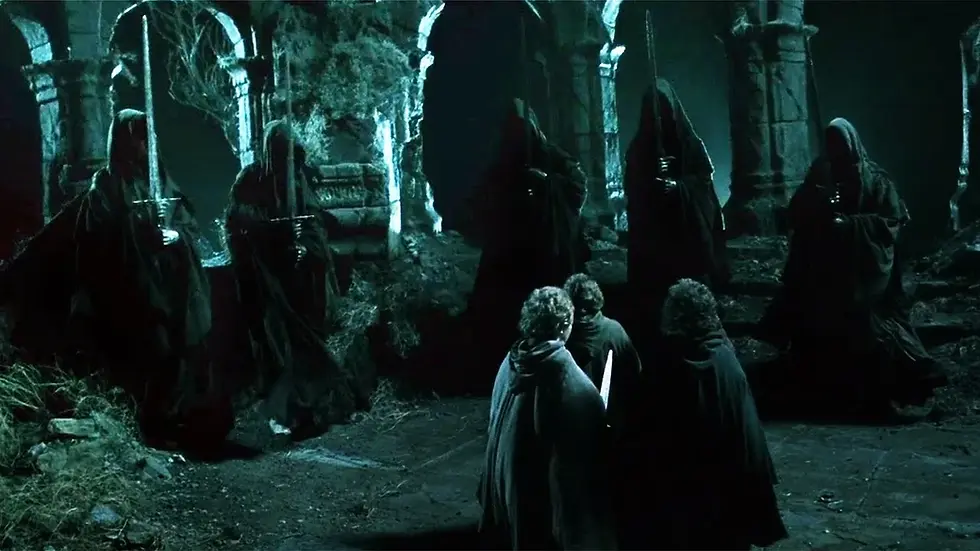
The Morgul Blade — The Cursed Dagger of the Nazgûl
The Morgul Blade is not a sword in the conventional sense — it is something far more sinister. A long, thin dagger forged in the dark realm of Morgul, it was designed not to kill its victim outright but to leave a splinter of its blade in the wound, slowly transforming the victim into a wraith — a shadow creature bound to Sauron's will, destined to become another Ringwraith.
It is the Morgul Blade that the Witch-King drives into Frodo's shoulder on Weathertop — the wound that nearly costs Frodo his life and his soul, and that drives the urgency of the Fellowship's race to Rivendell in the opening act of The Fellowship of the Ring. The blade itself is extraordinary in design — slender, asymmetric, and deeply unsettling, its very appearance suggesting something wrong with the world. It is a collector's piece for those who appreciate the more esoteric corners of Tolkien's mythology.
Shop our Morgul Blade replica — available with display plaque and free UK delivery

The Twin Knives of Legolas Greenleaf — Blades of the Woodland Realm
Legolas Greenleaf, Prince of the Woodland Realm of Mirkwood, is primarily known as an archer — but his twin long knives are every bit as much a part of his fighting style as his bow. In Peter Jackson's films, Legolas uses his knives in fluid, acrobatic close-quarters combat that reflects the Elvish warrior tradition of the Woodland Realm — light, fast, and devastatingly precise.
The knives are distinctively Elvish in design — long enough to function as short swords, with elegant curves and the organic, nature-inspired aesthetic that characterises all Woodland Elf craftsmanship. Where the swords of Gondolin — Sting and Glamdring — reflect the high, courtly Elvish culture of the First Age, Legolas's blades reflect the wilder, more primal Elves of Mirkwood, who maintained their connection to the natural world rather than retreating into the refined splendour of Rivendell or Lothlórien.
As a display piece, the twin knives of Legolas are one of the most visually striking options in our collection — particularly when displayed together as a matching pair.
Shop our Legolas twin knives replica — available with display plaque and free UK delivery

Thranduil's Sword — The Blade of the Elven King of Mirkwood
Thranduil, the Elven King of Mirkwood and father of Legolas, wields one of the most distinctive swords in the Hobbit trilogy — a long, elegant blade that perfectly reflects the character of its wielder: ancient, imperious, and formidably dangerous beneath a surface of cold refinement.
Thranduil is a king who has ruled Mirkwood for thousands of years, who fought in the War of the Last Alliance at the end of the Second Age and watched his father Oropher die in battle against Sauron's armies. His sword carries that weight of history — a blade that has seen more of Middle-earth's story than almost any other weapon in the trilogies. In the Hobbit films, Thranduil's fighting style is as extraordinary as his sword — fluid and almost balletic, the style of an Elf who has been perfecting his craft for millennia.
The sword's design is unmistakably Woodland Elf in aesthetic — longer and more slender than the swords of Gondor, with the organic elegance that characterises Mirkwood craftsmanship. For fans of the Hobbit trilogy and Elvish culture in particular, it is one of the most sought-after display pieces in our collection.
Shop our Thranduil's sword replica — available with display plaque and free UK delivery

The Broken Sword of Sauron — The Rings of Power
The Broken Sword of Sauron occupies a unique place in our collection — the only blade drawn from Amazon's The Rings of Power rather than Peter Jackson's film trilogies, and one that connects directly to the deepest history of Middle-earth's Second Age.
In The Rings of Power, the broken sword hilt is discovered in the Southlands — the ancient relic of Sauron's presence in the region during the darkest period of the Second Age, long before the events of The Lord of the Rings. It is a blade associated with the origins of Mordor itself, the physical evidence of Sauron's corruption of the lands and peoples of Middle-earth before his defeat at the hands of the Last Alliance.
As a collector's piece, the Broken Sword of Sauron is one of the most distinctive items in our range — its fractured, dark design setting it apart from every other blade in the collection. It is the choice for serious collectors who want to represent not just the Third Age story of The Lord of the Rings, but the full sweep of Tolkien's legendarium across the ages.
Shop our Broken Sword of Sauron replica — available with display plaque and free UK delivery
Conclusion: The Swords of Middle-earth as Collector's Pieces
What makes the swords of Middle-earth extraordinary as collector's pieces is precisely what makes them extraordinary in Tolkien's writing: every one of them has a story that goes far deeper than the moment it appears on screen. Andúril carries three thousand years of history. Sting survived the destruction of an entire civilisation. Glamdring was the sword of a king whose city was destroyed before recorded history. These are not just replica swords — they are physical connections to one of the richest fictional universes ever created.
Our Lord of the Rings replica sword collection brings the most iconic of these blades home, crafted in stainless steel with the attention to detail that Tolkien's legendarium deserves. Each sword arrives with a wooden display plaque included as standard — ready to mount straight out of the box. Free UK delivery on all orders.
Browse the full Lord of the Rings replica sword collection
Comments